本文へ進む
メニュー
医学部数学 過去問DB問題を探す

旭川医科大学/2017年度

旭川医科大学 2017年 数学 第3問解答・解説

このページには広告が含まれます。

1問題

旭川医科大学2017年度第3問

O を原点とする座標平面上に長さ 1 の線分 AB がある.線分 AB の端点 A は x 軸上の x≧0x \geq 0 の部分を,端点 B は y 軸上の y≧0y \geq 0 の部分を動くものとする.このとき,次の問いに答えよ.

問 1 線分 AB が x 軸となす角 ∠OAB が θ であるとき, 直線 AB を LθL_{\theta} で表す. 直線 LθL_{\theta} の方程式を求めよ. ただし, 0≦θ<π2\displaystyle 0 \leq \theta < \frac{\pi}{2} である.

問 2 t は 0<t≦10 < t \leq 1 を満たす定数とする.直線 x = t と直線 LθL_{\theta} との交点を PθP_{\theta} とする.点 PθP_{\theta} の y 座標が最大となる θ\theta を α\alpha とするとき, cos⁡α\cos \alpha を t を用いて表せ.

問 3 点 PαP_{\alpha} の直交座標 (x,y)(x, y) を α\alpha を用いて表せ.また α=π4\displaystyle \alpha = \frac{\pi}{4} のとき,点 PαP_{\alpha} の極座標を求めよ.

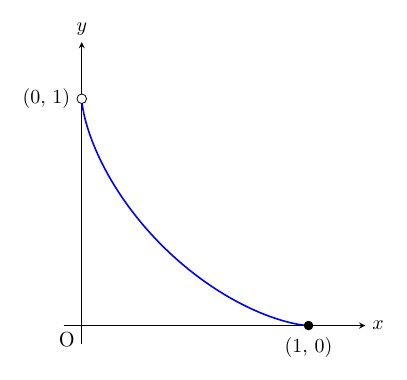
問 4 α\alpha が 0≦α<π2\displaystyle 0 \leq \alpha < \frac{\pi}{2} の範囲を動くとき, 点 PαP_{\alpha} の描く曲線を CC とする. CC 上の点 PαP_{\alpha} における接線が LαL_{\alpha} であることを示し, CC の概形を図示せよ.

まずは自分で解いてみましょう。詰まったら「考え方」、解けたら「答え」で確かめられます。

2考え方

考え方を見る解き方の方針だけを確かめる

直角三角形の三角比で直線を表し、微分で最大値と媒介変数曲線の接線を求める。

3答え

答えを見る自分の答えと照らし合わせる
  • Lθ: xsin⁡θ+ycos⁡θ=sin⁡θcos⁡θ,cos⁡α=t3,Pα=(cos⁡3α,sin⁡3α),α=π4 のとき (r,φ)=(12,π4),C: x2/3+y2/3=1(x>0, y≧0),接線 Lα: xsin⁡α+ycos⁡α=sin⁡αcos⁡α.\displaystyle \begin{aligned} &L_\theta:\space{}x\sin\theta+y\cos\theta=\sin\theta\cos\theta,\qquad \cos\alpha=\sqrt[3]{t},\\ &P_\alpha=(\cos^3\alpha,\sin^3\alpha),\qquad \alpha=\frac{\pi}{4}\text{ のとき }(r,\varphi)=\left(\frac12,\frac{\pi}{4}\right),\\ &C:\space{}x^{2/3}+y^{2/3}=1\quad(x>0,\space{}y\ge0),\qquad \text{接線 }L_\alpha:\space{}x\sin\alpha+y\cos\alpha=\sin\alpha\cos\alpha. \end{aligned}

4解答

解答を見る途中式つきの解答

線分の長さが 11 で、∠OAB=θ\angle OAB=\theta だから、A=(a,0),B=(0,b)A=(a,0),B=(0,b) とおくと a2+b2=1,tan⁡θ=ba,\displaystyle a^2+b^2=1,\qquad \tan\theta=\frac{b}{a}, よって a=cos⁡θ, b=sin⁡θa=\cos\theta,\ b=\sin\theta である。切片形から Lθ: xcos⁡θ+ysin⁡θ=1\displaystyle L_\theta:\ \frac{x}{\cos\theta}+\frac{y}{\sin\theta}=1 を得る(θ>0\theta>0 の場合)。θ=0\theta=0 も含む式は xsin⁡θ+ycos⁡θ=sin⁡θcos⁡θ,すなわちy=sin⁡θ−xtan⁡θ.\boxed{x\sin\theta+y\cos\theta=\sin\theta\cos\theta}, \qquad\text{すなわち}\qquad \boxed{y=\sin\theta-x\tan\theta}. 特に θ=0\theta=0 では y=0y=0 である。

問2で x=tx=t を代入すると、PθP_\theta の yy 座標は f(θ)=sin⁡θ−ttan⁡θ,f′(θ)=cos⁡θ−tsec⁡2θ=cos⁡3θ−tcos⁡2θ.\displaystyle f(\theta)=\sin\theta-t\tan\theta,\qquad f'(\theta)=\cos\theta-t\sec^2\theta =\frac{\cos^3\theta-t}{\cos^2\theta}. cos⁡3θ\cos^3\theta は 0≦θ<π/20\le\theta<\pi/2 で単調減少する。したがって 0<t<10<t<1 なら、f′f' は cos⁡3θ>t\cos^3\theta>t の間正、cos⁡3θ<t\cos^3\theta<t の間負であり、最大点は cos⁡3α=t\cos^3\alpha=t を満たす。t=1t=1 なら f′(0)=0f'(0)=0、θ>0\theta>0 で f′(θ)<0f'(\theta)<0 なので最大点は α=0\alpha=0 であり、同じ式を満たす。ゆえに cos⁡α=t3.\boxed{\cos\alpha=\sqrt[3]{t}}.

問3では t=cos⁡3αt=\cos^3\alpha を用いて Pα=(t,sin⁡α−ttan⁡α)=(cos⁡3α, sin⁡α−cos⁡2αsin⁡α)=(cos⁡3α,sin⁡3α).P_\alpha=\left(t,\sin\alpha-t\tan\alpha\right) =\left(\cos^3\alpha,\ \sin\alpha-\cos^2\alpha\sin\alpha\right) =\boxed{(\cos^3\alpha,\sin^3\alpha)}. α=π/4\alpha=\pi/4 のとき Pα=(2/4,2/4)P_\alpha=(\sqrt2/4,\sqrt2/4) だから r=x2+y2=12,φ=π4.\displaystyle r=\sqrt{x^2+y^2}=\frac12,\qquad \varphi=\frac{\pi}{4}. 極座標は (r,φ)=(1/2,π/4)\boxed{(r,\varphi)=(1/2,\pi/4)}。

問4では x=cos⁡3α,y=sin⁡3αよりx2/3+y2/3=cos⁡2α+sin⁡2α=1.x=\cos^3\alpha,\quad y=\sin^3\alpha \quad\text{より}\quad x^{2/3}+y^{2/3}=\cos^2\alpha+\sin^2\alpha=1. 0≦α<π/20\le\alpha<\pi/2 より、これは (1,0)(1,0) を含み (0,1)(0,1) に近づく第一象限の弧である。0<α<π/20<\alpha<\pi/2 では dxdα=−3cos⁡2αsin⁡α,dydα=3sin⁡2αcos⁡α,dydx=−tan⁡α.\displaystyle \frac{dx}{d\alpha}=-3\cos^2\alpha\sin\alpha,\qquad \frac{dy}{d\alpha}=3\sin^2\alpha\cos\alpha, \qquad \frac{dy}{dx}=-\tan\alpha. 一方 Pα=(cos⁡3α,sin⁡3α)P_\alpha=(\cos^3\alpha,\sin^3\alpha) は xsin⁡α+ycos⁡α=sin⁡αcos⁡3α+cos⁡αsin⁡3α=sin⁡αcos⁡αx\sin\alpha+y\cos\alpha =\sin\alpha\cos^3\alpha+\cos\alpha\sin^3\alpha =\sin\alpha\cos\alpha を満たす。この直線の傾きも −tan⁡α-\tan\alpha なので、PαP_\alpha における接線は xsin⁡α+ycos⁡α=sin⁡αcos⁡α=Lα.\boxed{x\sin\alpha+y\cos\alpha=\sin\alpha\cos\alpha}=L_\alpha. 端点 α=0\alpha=0 については lim⁡α→0+y−0x−1=lim⁡α→0+sin⁡3αcos⁡3α−1=0\displaystyle \lim\limits _{\alpha\to0+}\frac{y-0}{x-1} =\lim\limits _{\alpha\to0+}\frac{\sin^3\alpha}{\cos^3\alpha-1}=0 だから、端点での接線も y=0=L0y=0=L_0 である。概形は次のとおり((0,1)(0,1) は含まない極限点)。

原点Oと右向きのx軸・上向きのy軸の第一象限に、曲線C:x^(2/3)+y^(2/3)=1(x=cos³α, y=sin³α)の弧を青線で描いている。弧はy軸上の点(0, 1)(白丸で、含まない)から原点側にへこみながら下り、x軸上の点(1, 0)(黒丸で、含む)に達し、両端でそれぞれy軸・x軸に接している。

この問題で使う考え方

  • 三角比と相互関係
  • 直線の方程式
  • 関数の極限
  • 三角関数の微分
  • 合成関数の微分
  • 曲線の接線
  • 曲線の媒介変数表示
  • 極座標と極方程式

PR

数学を1対1で教わるオンライン塾「数強塾」

数強塾は、中学生・高校生のための数学専門のオンライン個別指導塾です。プロ講師がマンツーマンで教え、大学受験の数学にも対応しています。入塾の前に、今の学習状況と目標を確かめる診断授業(体験・3,000円、税込)を受けられます。

「数強塾」オンライン数学克服塾〈プロ講師〉

東大生と1対1で学べるオンライン個別指導「トウコベ」

トウコベは、東大生を中心に難関大学の学生が講師を務める、完全マンツーマンのオンライン個別指導です。はじめに、オンラインの説明会・勉強相談(無料)をWebで予約でき、その後にお試し授業を受けられます。

トウコベ公式サイト

似た問題を、ほかの大学で

答えや解説の誤りに気づいたら、お問い合わせから教えてください。